
Formation Flight
Supports line, triangle, rectangle, circle, orbiting-circle, and formation switching. It also includes master-slave following, autonomous task allocation, position correction, and other auxiliary functions.
AMOVLAB Solution
A UAV swarm formation and obstacle avoidance platform based on the P600 multi-UAV formation development kit, combining formation flight, LiDAR-based perception, local mapping, and cooperative obstacle avoidance.
The solution keeps the core functions of the UAV swarm formation package while adding autonomous obstacle avoidance for complex environments, helping researchers validate swarm navigation and obstacle avoidance algorithms on a practical full-stack platform.
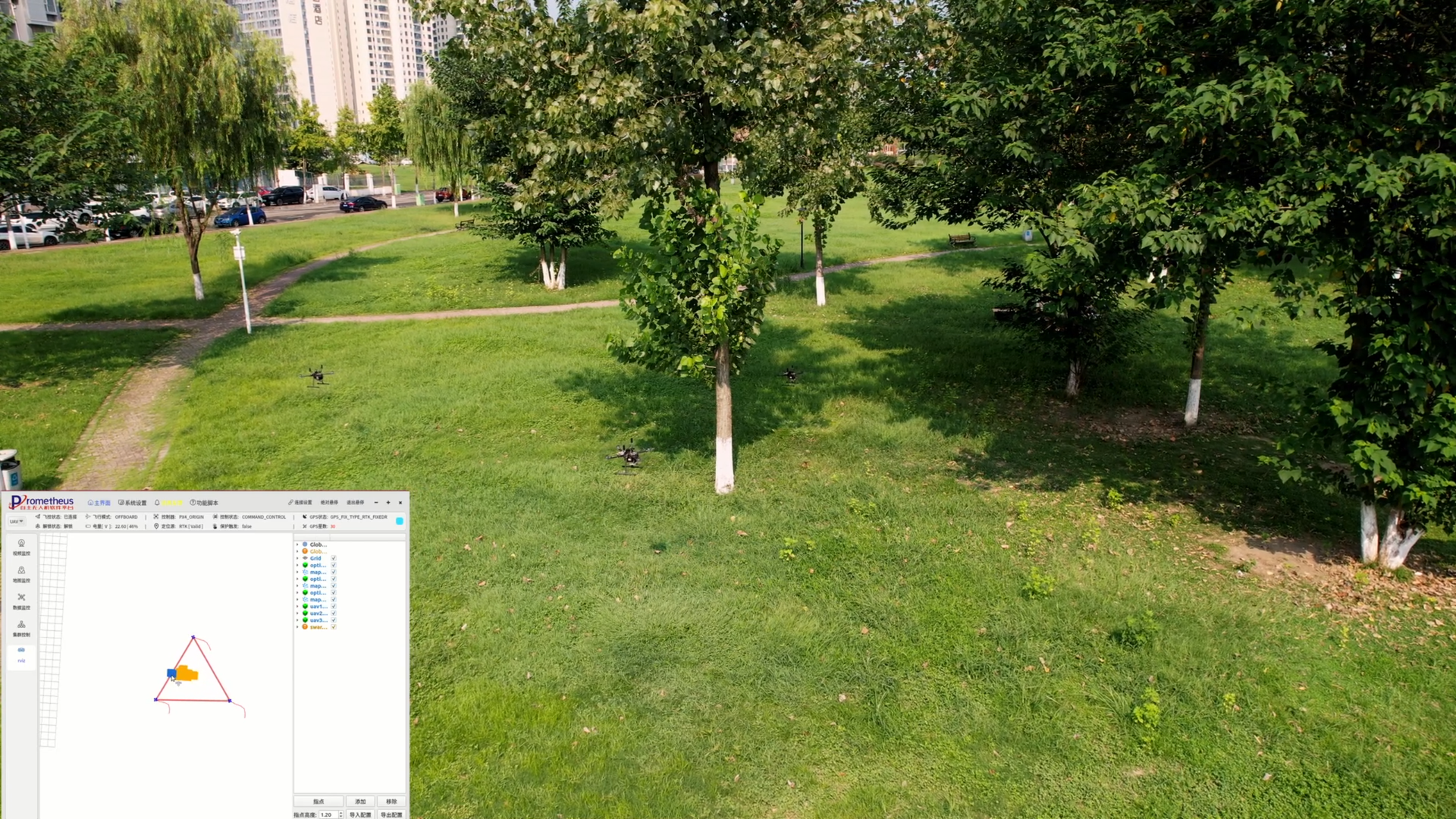
Solution Overview
The UAV swarm formation obstacle avoidance package is built on the P600 three-UAV formation development kit. It integrates AMOVLAB's swarm formation obstacle avoidance algorithm, combining formation control and obstacle avoidance into one experimental platform.
By introducing 3D LiDAR for environmental perception, the system enables UAVs to perceive surrounding obstacles in real time, build local maps, plan avoidance paths, and maintain formation integrity through spacing adjustment and flexible formation stretching.
Core Functions
Supports line, triangle, rectangle, circle, orbiting-circle, and formation switching. It also includes master-slave following, autonomous task allocation, position correction, and other auxiliary functions.
UAVs use 3D LiDAR to perceive the surrounding environment and build local maps in real time. The system plans avoidance paths based on aircraft position and obstacle information while preserving the overall formation.
The swarm adjusts spacing and stretches elastically during avoidance, reducing formation disorder that can happen when only a single UAV reacts to an obstacle.
The system monitors communication, positioning, flight mode, and other status data during swarm operation. Abnormal states trigger prompts and autonomous protection to reduce crash risk and equipment loss.
Ground-station software displays connection status, flight mode, position, speed, attitude, 2D/3D maps, and task controls including takeoff, mission setup, formation setting, hovering, and landing.
Includes indoor and outdoor positioning modes, three UAV flight models, and adaptation to the swarm-control system and ground-station workflow, helping developers migrate simulation results to physical aircraft.
Each UAV carries an onboard computing unit. Aircraft communicate through data links, while task control and planning run onboard. The ground station is used for remote display and task issuing.
Purchasers receive access to most of the swarm-system source code, excluding ground-station software, together with secondary-development interfaces for further research.
AMOVLAB can provide software and hardware customization based on project requirements and the UAV swarm obstacle avoidance package.
Application Directions
Supports research in multi-agent collaborative control, formation control, path planning, obstacle avoidance, and other swarm-intelligence algorithms.
Provides an integrated teaching platform for demonstrating UAV technology, swarm collaboration principles, and autonomous obstacle avoidance workflows.
Technical Parameters
| Parameter | AllSpark2-Orin-Nano | AllSpark2-Orin-NX (8GB) |
|---|---|---|
| AI Performance | 40 TOPS | 70 TOPS |
| GPU | 1024-core NVIDIA Ampere GPU with 32 Tensor Cores | 1024-core NVIDIA Ampere GPU with 32 Tensor Cores |
| Maximum GPU Frequency | 625 MHz | 765 MHz |
| CPU | 6-core ARM Cortex-A78AE v8.2 64-bit CPU, 1.5 MB L2 + 4 MB L3 | |
| Maximum CPU Frequency | 1.5 GHz | 2 GHz |
| DL Accelerator | / | 1x NVDLA v2 |
| DLA Maximum Frequency | / | 614 MHz |
| Vision Accelerator | / | 1x PVA v2 |
| External Storage | 128 GB SSD, M.2 Key M, NVMe protocol | |
| Display Interface | 1 micro HDMI display interface, supports 1920 x 1080P output | |
| CSI Interface | 2-channel MIPI CSI 2-lane interface | |
| Ethernet | 2x 100 Mbps Ethernet ports | |
| WiFi | Built-in WiFi mini PCIe module with external antenna support | |
| USB | 1x USB 3.2 Type-A, 1x USB 3.2 Type-C, and 1x micro USB for flashing | |
| GPIO | 4 GPIO channels, CMOS 3.3 V | |
| CAN Transceiver | Supports CANH and CANL communication | |
| UART | 4 UART channels, CMOS 3.3 V, including 1 debug UART | |
| I2C | 1 I2C channel, CMOS 3.3 V | |
| SPI | 1 SPI channel, CMOS 3.3 V | |
| Power Input | XT30M, 10-26 V at 3 A | |
| System Power | 6-25 W | |
| Weight | About 188 g | |
| Dimensions | 102.5 mm x 62.5 mm x 31 mm | |
| Parameter | Large UAV |
|---|---|
| Type | Multirotor UAV |
| Wheelbase | 600 mm |
| Maximum Takeoff Weight | 4.0 kg |
| Maximum Payload | 1.5 kg |
| Maximum Horizontal Speed | 12 m/s |
| Maximum Climb Speed | 5 m/s |
| Maximum Descent Speed | 3 m/s |
| Hover Time | 70 min unloaded; 30 min with 1.5 kg payload |
| Parameter | Homer |
|---|---|
| Interface | 3x serial, 3x Ethernet |
| Frequency Band | 5.1 GHz to 5.9 GHz |
| Maximum Bandwidth | 80 Mbps |
| Maximum Distance | 2.5 km |
| Maximum Nodes | 12 |
| Dimensions | 88 mm x 78 mm x 20 mm |
| Parameter | RTK |
|---|---|
| Positioning Accuracy | 2-4 cm |
| Application Scenario | Outdoor |
| Positioning Data | 3D position data |
| Parameter | MID360 |
|---|---|
| Wavelength | 905 nm |
| Eye Safety | Class 1, IEC60825-1:2014 |
| Detection Range at 100 klx | 40 m at 10% reflectivity; 70 m at 80% reflectivity |
| Near Blind Zone | 0.1 m |
| Field of View | Horizontal 360 deg; vertical -7 deg to 52 deg |
| Ranging Random Error | <= 2 cm at 10 m; <= 3 cm at 0.2 m |
| Angular Random Error | < 0.15 deg |
| Point-Cloud Frame Rate | 10 Hz |
| Data Interface | 100BASE-TX Ethernet |
| IMU | Built-in ICM40609 |
| Operating Temperature | -20 C to 55 C |
| Protection Rating | IP67 |
| Power Consumption | 6.5 W |
| Power Supply | 9-27 V DC |
| Dimensions | 65 mm x 65 mm x 60 mm |
| Weight | 265 g |
Project Case
Contact Us
Obstacle avoidance tests depend on obstacle density, flight speed, sensing range, and how the swarm should react.
Useful details to include
Thanks for subscribing!
This email has been registered!


