AMOVLAB Solution

Air-Ground-Sea Collaboration Solution

A high-end secondary-development platform for heterogeneous multi-robot collaboration research, integrating UAVs, unmanned ground vehicles (UGVs), unmanned surface vehicles (USVs), computing units, communication links, positioning, sensors, and collaboration-control software.

The platform provides a high-fidelity ROS / Gazebo simulation environment, collaboration demos, detailed technical documentation, and a fully open architecture. Researchers can quickly validate algorithms and carry out deep secondary development for intelligent swarm systems.

AMOVLAB air-ground-sea collaboration solution

A complete platform for air-ground-sea multi-robot collaboration research.

The air-ground-sea collaboration package is tailored for heterogeneous robot swarm collaboration research. It supports UAV + UGV, UAV + USV, and expandable UAV-UGV-USV configurations, integrating advanced collaboration platforms, high-performance computing units, efficient communication modules, high-precision positioning modules, multimodal sensor systems, and a powerful collaboration-control software system.

The platform covers both hardware and software requirements, giving research teams a ready foundation for algorithm verification, system integration, and advanced experiments in heterogeneous intelligent swarms.

Air-ground collaboration, open code, simulation, flexible configuration, and customization.

01

Air-Ground Collaboration

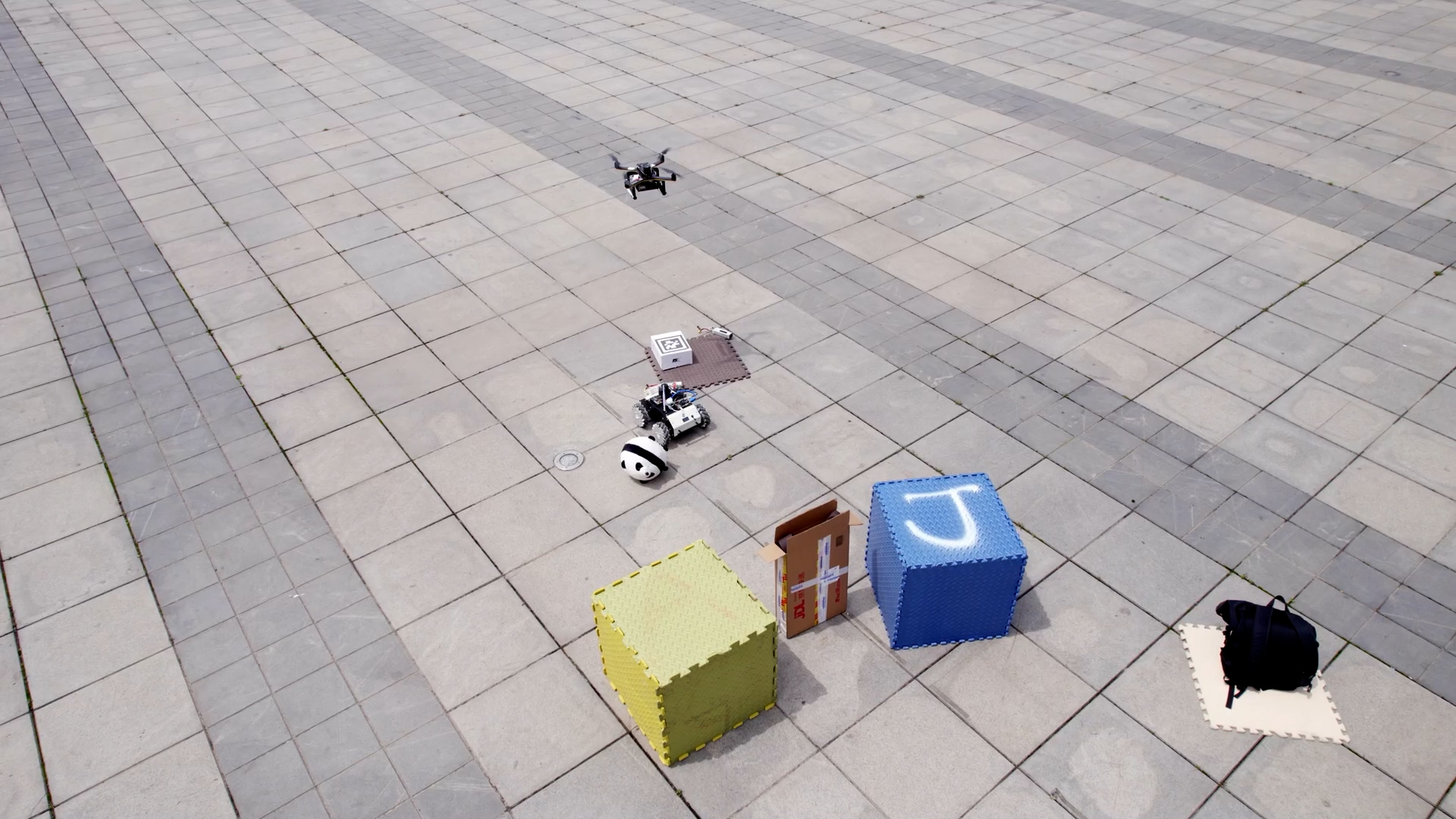
The UAV autonomously plans a route to search a defined area and uses its onboard camera to detect ground targets. After a QR-code target is detected and tracked, the UAV calculates the target position and sends it to the unmanned ground vehicle. The UGV then navigates to the target point and uses its LiDAR module to sense surrounding obstacles and avoid them during navigation.

02

Open Code

UAV and UGV control code, UGV navigation and obstacle-avoidance functions, UAV visual QR-code recognition, air-ground-sea collaboration demos, and other software modules are open source with Chinese comments to help users start secondary development quickly.

03

Simulation System

The platform provides an air-ground-sea collaboration simulation system based on ROS / Gazebo. Users can develop and verify related software functions in simulation before deploying them to the real system.

04

Flexible Solution

Representative UAV + UGV package combinations such as R200-Z410 and R300-P600 are available, with the same architecture extendable to UAV + USV and UAV-UGV-USV collaboration scenarios.

05

Customization Support

AMOVLAB can provide software and hardware customization based on user requirements and the target research scenario.

Heterogeneous swarm algorithms and teaching demonstrations.

Swarm Algorithm Research

Supports research in multi-agent heterogeneous collaborative control, path planning, visual perception, and related algorithms.

Teaching Demonstration

Serves as a teaching platform to demonstrate UAV, UGV, USV, and heterogeneous multi-robot collaboration principles.

Core computing, vehicle, aircraft, communication, positioning, and sensor parameters.

1. Onboard Computer for UAV

ParameterAllSpark2-Orin-NanoAllSpark2-Orin-NX (8GB)
AI Performance40 TOPS70 TOPS
GPU1024-core NVIDIA Ampere GPU with 32 Tensor Cores1024-core NVIDIA Ampere GPU with 32 Tensor Cores
Maximum GPU Frequency625 MHz765 MHz
CPU6-core ARM Cortex-A78AE v8.2 64-bit CPU, 1.5 MB L2 + 4 MB L36-core ARM Cortex-A78AE v8.2 64-bit CPU, 1.5 MB L2 + 4 MB L3
Maximum CPU Frequency1.5 GHz2 GHz
DL Accelerator/1x NVDLA v2
Maximum DLA Frequency/614 MHz
Vision Accelerator/1x PVA v2
External Storage128 GB SSD, M.2 Key M, NVMe protocol128 GB SSD, M.2 Key M, NVMe protocol
Display Interface1 micro HDMI display interface, supports 1920 x 1080P output1 micro HDMI display interface, supports 1920 x 1080P output
CSI Interface2-channel MIPI CSI 2-lane interface2-channel MIPI CSI 2-lane interface
Ethernet2x 100 Mbps Ethernet ports2x 100 Mbps Ethernet ports
WiFiBuilt-in WiFi mini PCIe module with external antenna supportBuilt-in WiFi mini PCIe module with external antenna support
USB1x USB 3.2 Type-A, 1x USB 3.2 Type-C, 1x micro USB for flashing1x USB 3.2 Type-A, 1x USB 3.2 Type-C, 1x micro USB for flashing
GPIO4 GPIO channels, CMOS 3.3 V4 GPIO channels, CMOS 3.3 V
CAN TransceiverSupports CANH and CANL communicationSupports CANH and CANL communication
UART4 UART channels, CMOS 3.3 V, including 1 debug UART4 UART channels, CMOS 3.3 V, including 1 debug UART
I2C1 I2C channel, CMOS 3.3 V1 I2C channel, CMOS 3.3 V
SPI1 SPI channel, CMOS 3.3 V1 SPI channel, CMOS 3.3 V
Power InputXT30M, 10-26 V at 3 AXT30M, 10-26 V at 3 A
System Power6-25 W6-25 W
WeightAbout 188 gAbout 188 g
Dimensions102.5 mm x 62.5 mm x 31 mm102.5 mm x 62.5 mm x 31 mm

2. x86 Computing Unit

Parameterx86
CPUIntel 12th Gen Core i5-1240P, 12 cores, 16 threads, 4.4 GHz
GraphicsIntel Iris Xe Graphics
StorageSamsung 9A1 256 GB
Memory16 GB DDR5

3. Unmanned Ground Vehicle

ParameterR200R300
Dimensions472 x 378 x 189 mm612 x 580 x 245 mm
Maximum Speed7.2 km/h10 km/h
Maximum Payload20 kg10 kg
TiresRoad tires / Mecanum wheelsRoad tires / Mecanum wheels
Motion ModelDifferential driveDifferential drive
Maximum Range10 km10 km
Charging Time3 h2 h

4. UAV Frame

ParameterZ410P600
TypeMultirotor UAV
Wheelbase410 mm600 mm
Maximum Takeoff Weight2 kg4.0 kg
Maximum Payload0.6 kg1.5 kg
Maximum Horizontal Speed12 m/s12 m/s
Maximum Climb Speed3 m/s5 m/s
Maximum Descent Speed2 m/s3 m/s
Hover Time15 min unloaded, 10 min with 600 g payload70 min unloaded, 30 min with 1.5 kg payload

5. Communication Link

ParameterLQ Communication LinkMini HomerHomer
Interface2x serial, 2x Ethernet2x serial, 2x Ethernet3x serial, 3x Ethernet
Frequency Band2.4 GHz to 2.4835 GHzSub-1G band, 27 MHz to 960 MHz5.1 GHz to 5.9 GHz
Maximum Bandwidth40 Mbps11 Mbps80 Mbps
Maximum Distance3 km1 km2.5 km
Maximum Nodes8812
DimensionsAir unit: 49 mm x 34 mm x 15 mm
Ground unit: 94 mm x 64 mm x 23 mm
Air unit: 64 mm x 39 mm x 13 mm
Ground unit: 95 mm x 74 mm x 24 mm
88 mm x 78 mm x 20 mm

6. Positioning System

ParameterMOCAPRTK
Positioning AccuracyWithin 0.1 mm2-4 cm
Application ScenarioIndoorOutdoor
Positioning Data3D position plus 6-DOF attitude data3D position data

7. LiDAR

ParameterSlamtec S3
Measurement Radius0.05-40 m at 70% reflectivity
0.05-15 m at 10% reflectivity
0.05-5 m at 2% reflectivity
Blind Zone0.05 m
Sample Rate32,000 samples/s
Scan FrequencyTypical 10 Hz, adjustable from 10 Hz to 20 Hz
Range Resolution10 mm
Measurement Accuracy+/- 30 mm

8. Vision Sensor

ParameterGX40
Dimensions85.8 x 86 x 129.3 mm (gimbal)
45.4 x 40 x 13.5 mm (GCU controller)
Weight405 g (gimbal) + 18.6 g (GCU controller)
Operating Voltage14-53 VDC
Power Consumption8.5 W typical
55 W when stalled with lighting on
Operating Temperature-20 deg C to 50 deg C
Streaming TypeRTSP
GB/T28181
ONVIF
Encoding FormatH.264 / H.264H / H.264B / H.265 / MJPEG
Resolution4K at 30 fps
1080P at 30 fps
SCGA 1280 x 1024 at 30 fps
1.3M 1280 x 960 at 30 fps
720P at 30 fps
Bitrate0.25-10 Mbps at H.265
0.5-16 Mbps at H.264
Lens TypeOptical zoom lens
Focal Length4.8-48 mm
Aperturef/1.7-f/3.2
Diagonal FOV67.2 deg to 7.6 deg
Vertical FOV36.1 deg to 3.7 deg
Horizontal FOV60.2 deg to 6.6 deg
Optical Zoom10x
Image Sensor TypeCMOS
Effective Pixels8.29 MP
Sensor Size1/2.8 in
Pixel Size1.45 x 1.45 micrometer
Electronic Shutter1-1/30000 s
Minimum Illumination0.01 lux / f1.5 with night vision off
0.001 lux / f1.5 with night vision on
Stabilization ModeNon-orthogonal mechanical three-axis
Controllable AnglePitch: +157 deg to -70 deg
Roll: +/- 30 deg
Yaw: +/- 360 deg continuous
Maximum Control Speed200 deg/s
Angle Jitter+/- 0.01 deg

Contact Us

Planning an air-ground-sea robot system?

Air-ground-sea systems need clear task division between UAVs, UGVs, USVs, sensors, and communication links.

Useful details to include

  1. 01 Which vehicles need to collaborate and what each one does
  2. 02 Operating area, link distance, and positioning method
  3. 03 Simulation, real-world validation, and payload requirements